
Quick Summary
When dealing with persistent heel pain, memory foam feels comfortable for the first 10 minutes but quickly loses its supportive shape under your full body weight. Microcellular Rubber (MCR) is engineered with micro-sealed air pockets that provide continuous shock absorption without collapsing. For hard tile or marble floors, structural MCR support far outperforms memory foam for long-term foot health.
The Memory Foam Illusion: Softness vs. Real Support
Many people suffering from heel pain or plantar fasciitis buy memory foam slippers or insoles expecting instant relief. Memory foam is a visco-elastic polyurethane material designed to conform to the exact shape of your foot.
While this creates a soft, cloud-like feeling when you first step into the shoe, it introduces a major physical vulnerability: it lacks dynamic recovery force.
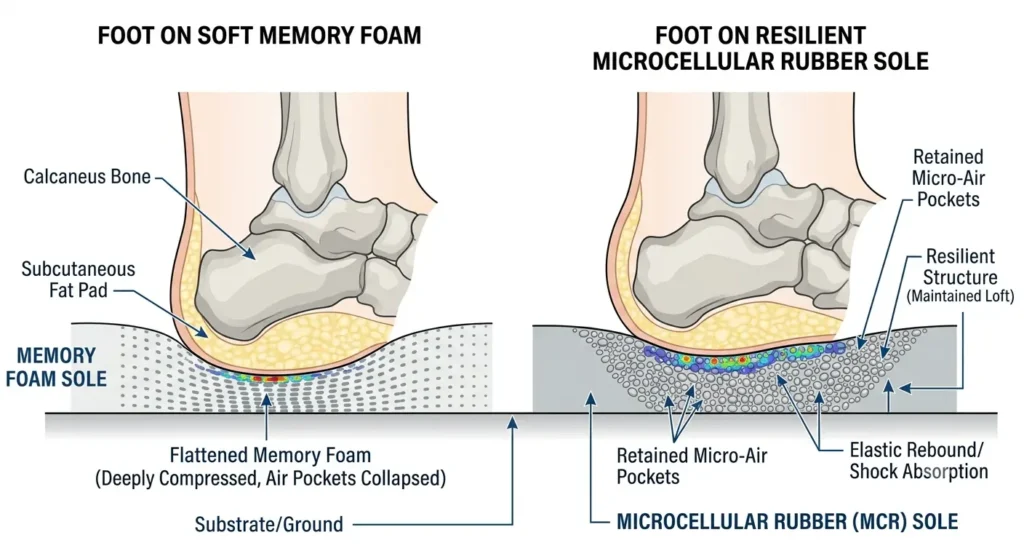
- The Compression Deficit: As you stand or walk on hard surfaces like concrete or tile, your body weight continuously compresses the foam cells.
- Bottoming Out: Within 15 to 30 minutes of continuous wear, standard memory foam fully flattens out.
- Impact Transmission: Once flattened, ground reaction forces pass directly through the compressed pad into your heel bone (calcaneus) and plantar fascia tissue.
How Microcellular Rubber (MCR) Handles Continuous Shock
Unlike visco-elastic memory foam, Microcellular Rubber (MCR) is specifically engineered for orthopedic load management. MCR is processed using specialized curing techniques that entrap millions of microscopic nitrogen gas pockets within a dense rubber polymer matrix.
Key Physical Differences:
| Technical Feature | Memory Foam (Visco-Elastic PU) | Microcellular Rubber (MCR) |
| Primary Mechanism | Conforms to foot shape via body heat | Absorbs vertical shock via encapsulated air cells |
| Response to Load | Flattens completely (“Bottoms Out”) | Deflects impact energy and spring-recovers |
| Arch Alignment | Low (allows arch to collapse inward) | High (maintains structural arch height) |
| Durability on Tile Floors | Degrades & compresses in 2–3 months | Maintains elastic recovery for 12+ months |
Biomechanical Impact on Hard Floors (Tile & Marble)
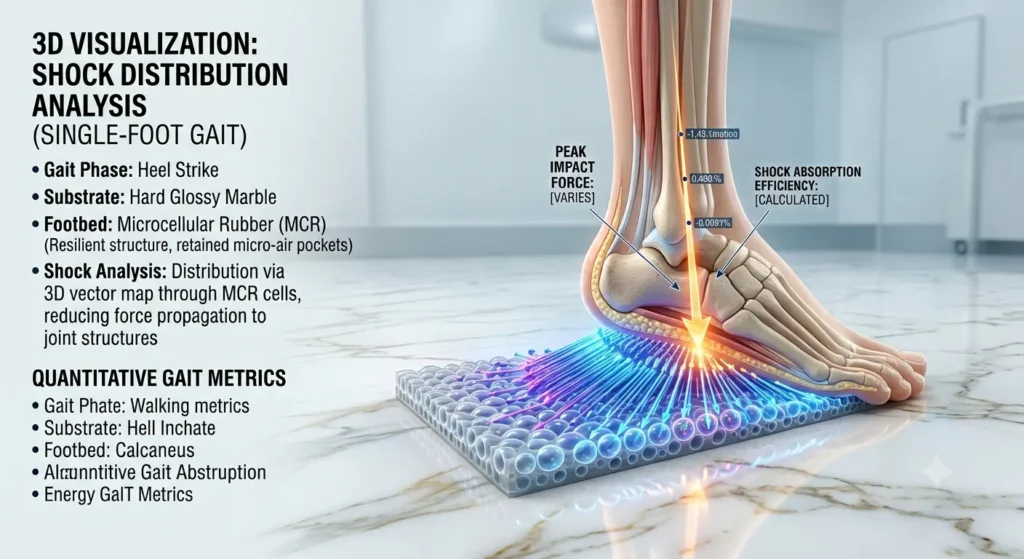
When walking barefoot or in flat shoes on unyielding household floors, your heel experiences repeated vertical shock spikes equal to 1.2 to 1.5 times your body weight.
- Memory Foam Response: Sink-in softness feels pleasant while sitting or taking a few steps, but offers zero resistance against excessive pronation (inward rolling of the foot).
- MCR Response: The rubber matrix acts as a active damper. As your heel strikes the ground, the micro-cells compress slightly to absorb peak kinetic energy, then immediately rebound to keep your calcaneus aligned.
Which Insole Material Do You Need?
Choose Memory Foam If:
- You want lightweight casual footwear for brief, low-impact wear around carpeted rooms.
- You do not suffer from structural heel pain, arch strain, or plantar fasciitis.
Choose Microcellular Rubber (MCR) Support If:
- You spend hours standing or walking on hard tile, marble, or concrete floors.
- You suffer from morning heel stiffness, calcaneal spurs, or flat foot fatigue.
- You need durable orthotic support that maintains its thickness and spring over time.
Recommended Orthopedic Support Products
(Note: Use affiliate link widgets below for monetization while building out your core product line)
- Option A (Structural Orthotic Support): Look for rigid-base orthotic insoles with deep heel cups and high-density rubber/EVA cores (e.g., [Insert Amazon Affiliate Link for High-Density Orthotic Insoles]).
- Option B (Everyday House Relief): Choose orthotic house slippers featuring contoured MCR/dense rubber footbeds specifically designed for hard indoor floors (e.g., [Insert Amazon Affiliate Link for Orthopedic House Slippers]).
Frequently Asked Questions (FAQ)
1. Is Microcellular Rubber (MCR) better than Memory Foam for Plantar Fasciitis?
Yes. Microcellular Rubber (MCR) provides resilient structural support with a calibrated Shore A hardness (20°–30°), keeping your arch elevated and dampening vertical shock. Memory foam collapses completely under body weight, leaving inflamed plantar fascia tissue exposed to hard floor impact.
2. Does MCR footwear lose its cushioning over time?
Unlike memory foam or EVA foam, which permanently flatten out (“bottom out”) after a few months of daily wear, MCR features microscopic closed gas cells within a flexible rubber matrix. This dynamic polymer structure retains its shape and elasticity for years without losing shock absorption.
3. Can I wear MCR slippers on hard tile or marble floors at home?
Absolutely. In fact, MCR house slippers are specifically engineered for unyielding indoor surfaces like ceramic tile, marble, and concrete. They protect the heel fat pad and prevent the sudden impact spikes that trigger morning heel pain.
4. Why does Memory Foam feel comfortable initially but cause foot pain later?
Memory foam offers high initial comfort because it molds instantly to your foot’s shape. However, because it lacks structural resistance, it flattens under your full weight during walking. This leaves your foot with zero arch support and forces your intrinsic foot muscles to overwork to keep balance.
5. Is MCR footwear suitable for people with diabetes?
Yes. MCR is widely recommended in preventive podiatry for diabetic foot care. Its smooth, non-abrasive texture reduces shear friction (which prevents friction blisters), while its uniform durometer density cushions sensitive nerve endings against micro-trauma.